
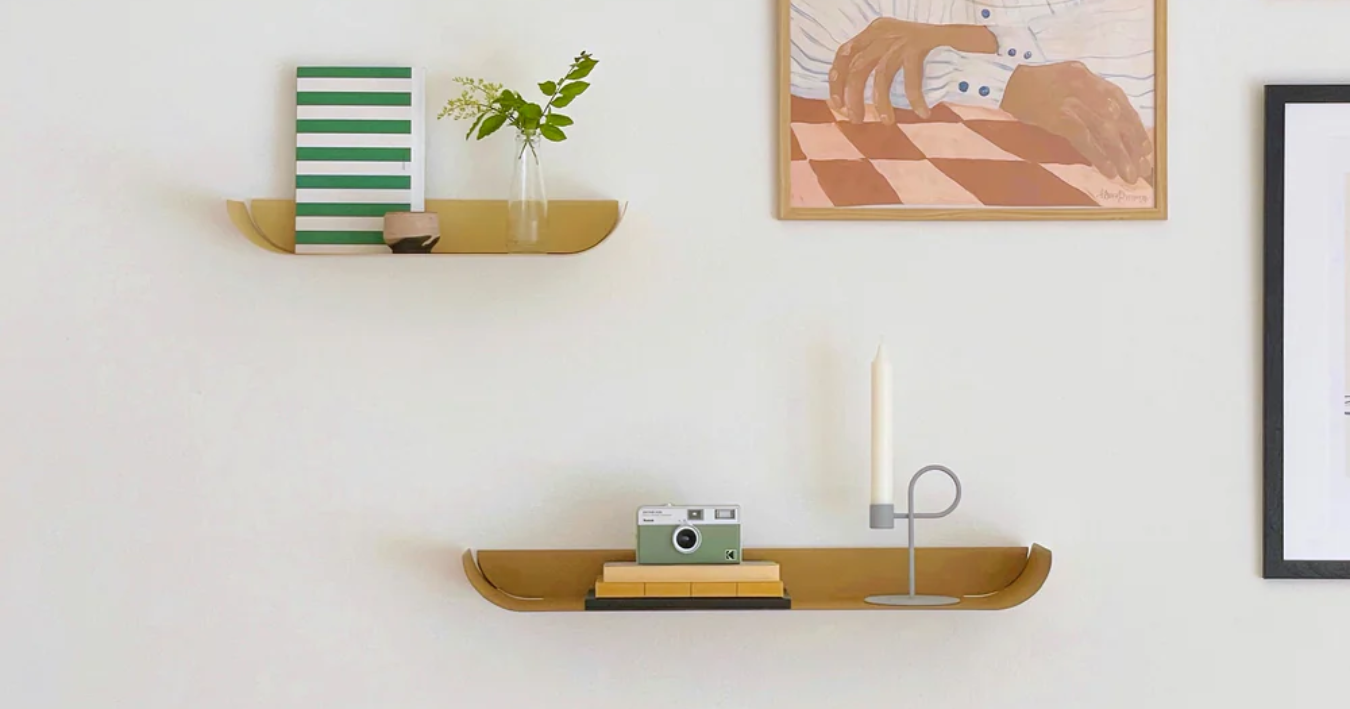
A wall decorated with a series of shelves may seem like the simplest solution in the world, until you find yourself staring at the wall with a drill in one hand and a level in the other and realize that perhaps the shelves you bought on impulse should have been a little shorter or longer, depending on the case.
First lesson to remember : the arrangement of the shelves must always follow a basic plan, whether this is just outlined in your head, or sketched on a piece of paper.
In this article you will find the golden rules for arranging shelves and some diagrams to copy .
How high should the shelves be placed?
One of the crucial questions that plagues anyone who finds themselves struggling with installing a shelf is: at what height do I mount it?
The answer isn't always clear-cut, but in these cases, anthropometric measurements can help.
Anthropometric measurements are measurements of the human body used to design spaces, furnishings, and objects to be comfortable, functional, and safe for most people. In practice, dimensions such as eye height, height of raised or outstretched hands, and the depth of arms and legs are studied to understand how we interact with our surroundings.
Shelves should be positioned according to our height and habits , so as to be ergonomic, safe and harmonious.
These measurements also implicitly tell you what is best to put on each shelf.
Here are the key measures to consider:
-
medium eye height (about 150–160 cm from the ground): this is the ideal spot to place decorative objects or books that you want to keep in sight.
-
maximum height reachable with the arms (approximately 190–200 cm) : beyond this threshold, a shelf becomes difficult to use without a stool.
- comfortable height for grabbing an object (approximately 120–140 cm) : perfect for the most used shelves, those at the base of the composition.
If the shelves are positioned too high or too low, in addition to losing functionality, they risk aesthetically unbalancing the entire harmony of the wall.
Here are the measurements to keep in mind when composing shelves.
-
The lowest shelf should be about 120–140 cm from the floor , easy to reach even without effort.
-
The top shelf is positioned around 180–200 cm from the floor , depending on the height of the ceiling and the objects you want to display.
- Leave at least 35–45 cm of space between shelves to maintain airiness and styling freedom.
If there is a piece of furniture underneath:
- start with the first shelf 25–40 cm above the cabinet ;
- the second shelf can rise another 30–40 cm , following a harmonious proportion.
The trick : look at the wall as a whole. Shelves should not only be convenient, but also fit well into the visual rhythm of the space.
After discussing ergonomics and functionality, let's move on to the more fun part: aesthetics. Here are some diagrams to draw inspiration from and suggestions for a harmonious composition.
1. Linear scheme: equal and aligned shelves
It's the most balanced choice, the one you'll never get tired of.
A series of identical shelves, aligned and mounted at regular intervals , is easy to manage and always harmonious, even with different objects. If the shelves are very long, they become a truly eye-catching display.
If you choose this arrangement:
-
you don't need architects , a good level is enough;
- ideal above desks or low furniture ;
- You can fill a small empty wall (such as the portion of wall between two adjacent doors) with a series of aligned shelves to give it character.
- If there is no furniture under the shelves , you can position the first shelf even lower than the standard 120 cm .

2. Do you have a piece of furniture under your shelves? Then it's the one that dictates the rules.
Shelves should have a width equal to or less than that of the cabinet and a depth always less than that of the furniture underneath.
Here are the golden rules to follow in these cases.
-
Align the cabinet and shelves perfectly . If the shelves are the same width as the cabinet, then you can align them in the center.
If they are smaller or of different sizes, you can align them with one of the sides of the furniture underneath (as in the image below).
-
How do you match shelves and the cabinet underneath? It's always best to differentiate materials and colors. If everything is too coordinated, nothing stands out.
The only exception? When you want the shelves and cabinet to disappear into the wall, you can choose the same color for the wall, the shelves, and the cabinet.
By the way, did you know that every Hiro shelf has a RAL code? If you want to use the same color as a Hiro piece of furniture on the walls of your home, just tell the paint shop the RAL color. Here you can find all the codes and color samples .
-
Clear roles: who's in charge? The piece of furniture is the star. The shelves complement it, but they shouldn't compete for attention. A complement (the shelves) can enhance a piece of furniture, but never steal the show .
 Alveo 40 cm shelves and Lido sideboard
3. Shelves in a niche? Make the most of the space.
Wall niches are perfect for enhancing with shelves and decor.
If there is no furniture underneath , filling them entirely with shelves creates a custom-made, tidy and welcoming bookcase effect.
If, however, the niche contains furniture that partially occupies it, respecting the proportions of the furniture below will create a tidy effect.
 Alveo 60 cm shelves and Milo coat rack
4. Staggered pattern? Only with discretion
Staggered shelves look creative, but they are much more difficult to manage.
They require even more careful study of the objects to be displayed and a balanced arrangement.
When they work well:
- if the composition is harmonious and proportionate to the wall;
- if you have few objects to display , well selected;
- if you fill the shelves only with books .
Avoid if: you love symmetry, you love visual order.

5. Empty wall furnished with shelves: when they become protagonists
A completely empty wall is a blank canvas . If you decide to decorate it with just shelves, then those shelves need to have plenty of character .
No anonymous solutions chosen simply to fill, " because something was needed ." Here, the shelves are no longer a support, but the main decorative element.
They must capture the eye, arouse curiosity, and give rhythm and movement to the space.
If the wall is empty and you want to decorate it only with shelves, it's better to choose a few iconic ones rather than many super-minimal ones.
Play with solids and voids ;
- alternate books, objects, paintings placed on the table;
- leave some empty space on the shelves (negative space enhances what's left).

By the way, if you're looking for ideas for decorating an empty wall, read also: How to enhance an empty wall: 4 ideas to copy and a shopping list .
Decorative shelves in the bedroom
The bedroom deserves a small chapter of its own. Here, the shelves are a perfect mix of function and play .
They must not only contain: they must tell .
You can use wavy shelves or rounded, colorful ones. The trick is not to overcrowd them and to think vertically.
Winning ideas:
- a row of shelves above the bed to display favorite books;
- colors that coordinate with the room's palette (or contrast to add energy).
In the bedroom, the height of the shelves should be considered based on the child's age, height and use .
This is where anthropometry comes into play: the science that studies the measurements of the human body to design spaces and objects to fit real people.

Children 3–6 years old
-
Eye height : approximately 95–105 cm
-
Accessible shelves : between 100 and 120 cm from the ground
-
High shelves (decorative only) : above 150 cm
Practical note : In the early years, it's advisable to avoid installations lower than 100 cm from the ground. At this age, children are short and full of energy, and there's always the risk of them banging their heads or using the shelves to climb.
Children 6–10 years old
-
Eye height: between 110 and 125 cm
-
Daily use shelves: 110–130 cm
-
High shelves for less used items: 140–160 cm
Boys 11+ / Pre-teens
- Now close to adult height, 130–150 cm eye height
-
Shelves for everyday use : between 120 and 150 cm
-
High shelves : 160–180 cm, to be managed with the help of a stool or for decorative purposes.
Every wall has its own rules, but the most important thing is to make shelves, furniture and objects interact with each other.
There's no need to overdo it: just a few well-arranged elements are enough.